On belonging.
Rugby saved my life. A portrait and conversation for Trouw about trans inclusion and starting over in Amsterdam.
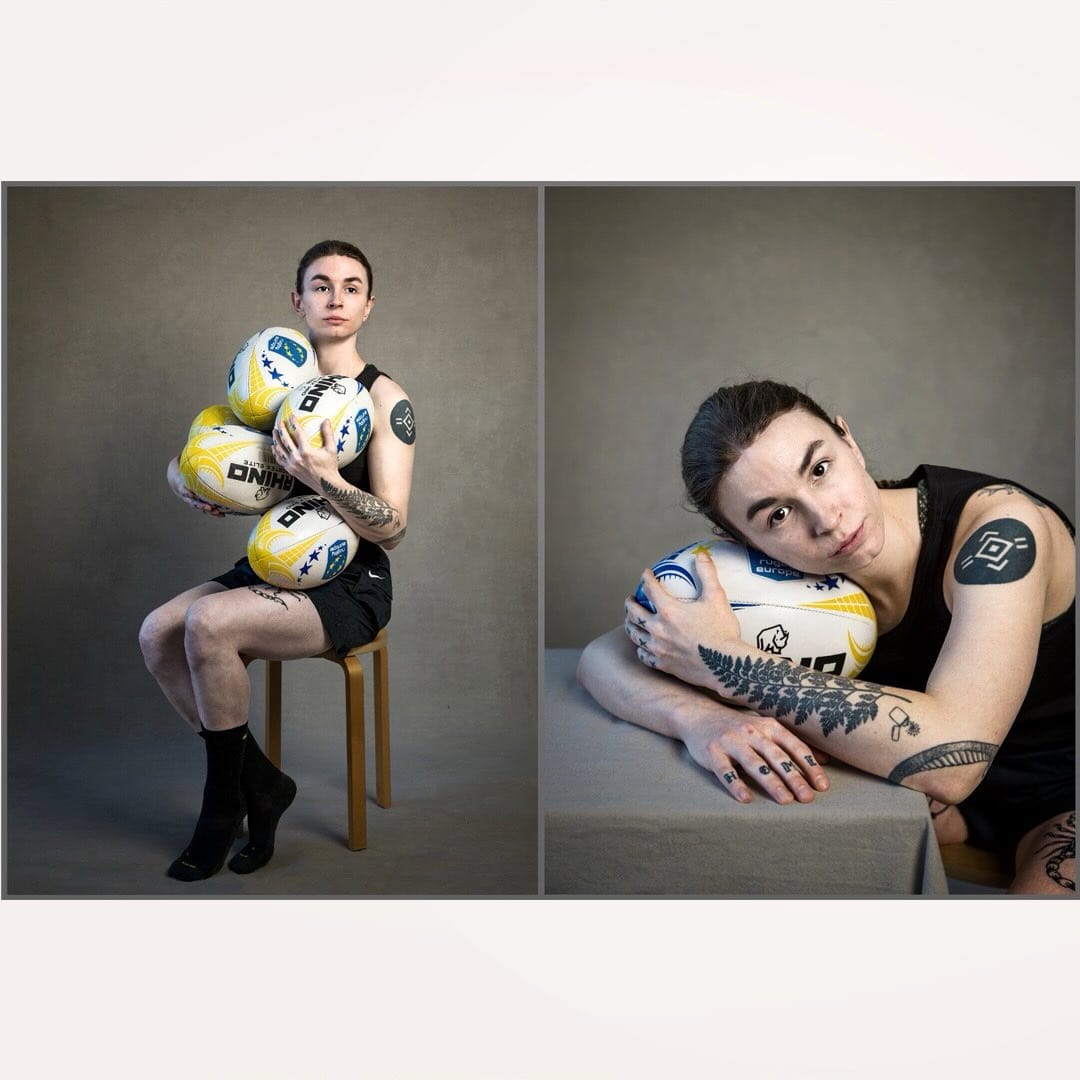
Originally shared on Instagram · 1 March 2026
“Rugby saved my life. I knew there was a team that supported me unconditionally.”
I shared my story with Esther Scholten for Trouw: rugby, trans inclusion, and leaving the United States to start over in Amsterdam.
These portraits are by Hadas Itzkovitch and Anya van Lit. Thank you for helping tell my story, and for making me feel so safe to share it.
At a time when sport is growing increasingly hostile toward trans athletes, I’m still fighting for our right to belong. Rugby gave me a team that supported me unconditionally. I want that for the people who come after me, too.
Interview: Esther Scholten for Trouw. Photography: Hadas Itzkovitch × Anya van Lit. With thanks to Rugby Nederland for their support.
The original Trouw article
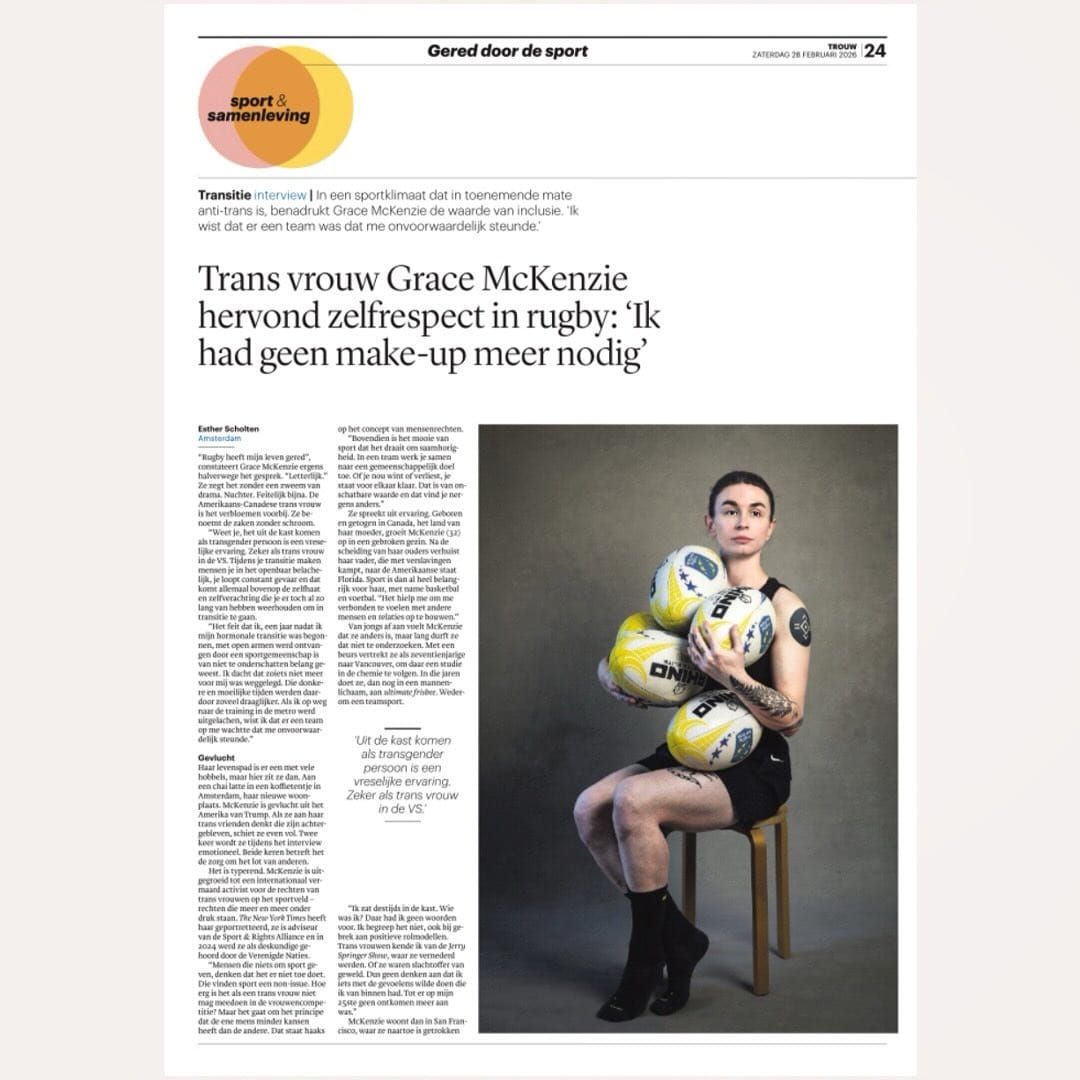
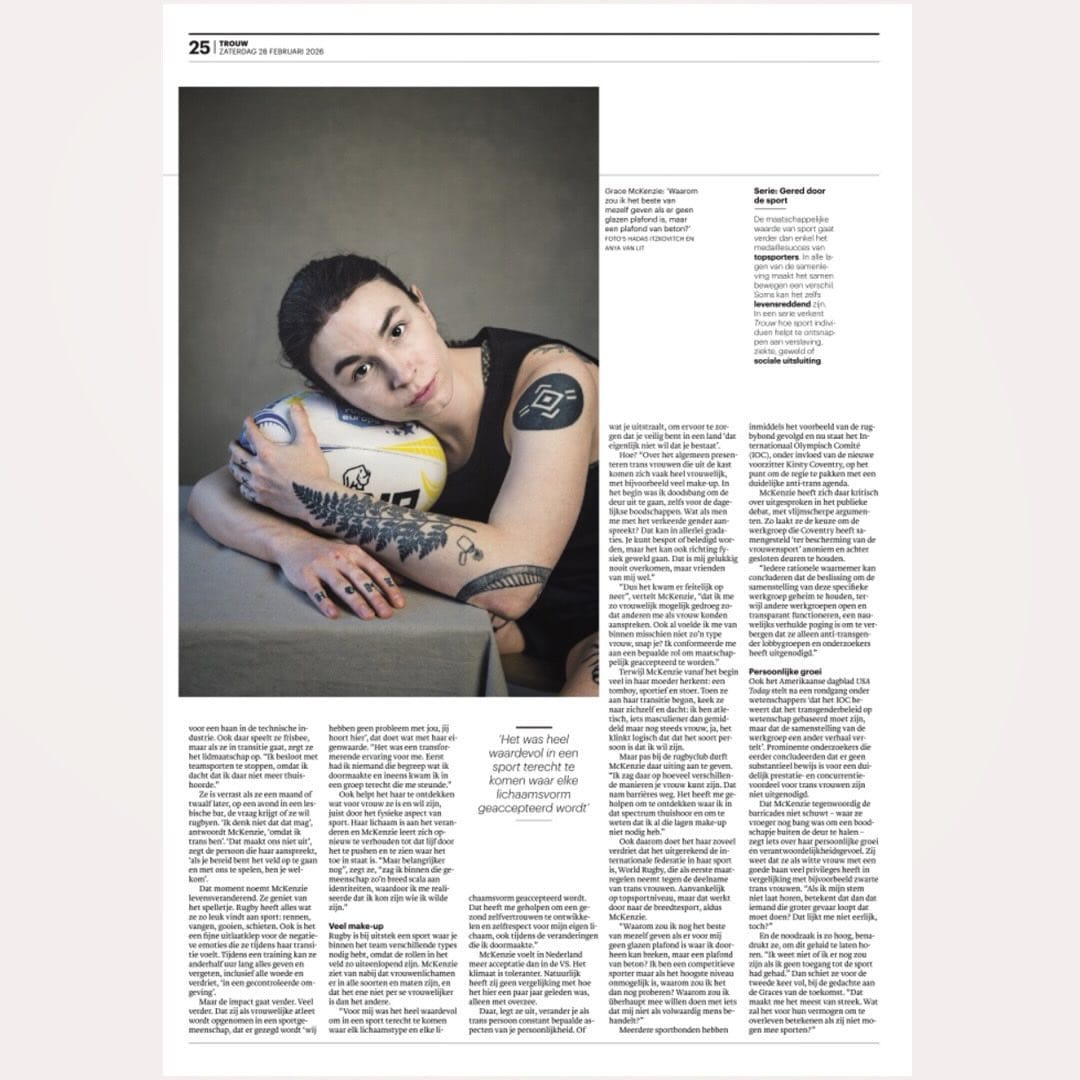
English translation
Translated from the Dutch article pictured above, published in Trouw on Saturday, 28 February 2026, pages 24–25. Text: Esther Scholten. Photography: Hadas Itzkovitch and Anya van Lit. This is an unofficial English translation; references to events and sports policies reflect the original article’s publication date.
Trans woman Grace McKenzie rediscovered self-respect through rugby: “I no longer needed make-up”
Transition | Interview
In a sporting climate that is becoming increasingly anti-trans, Grace McKenzie emphasizes the value of inclusion. “I knew there was a team that supported me unconditionally.”
Esther Scholten · Amsterdam
“Rugby saved my life,” Grace McKenzie says somewhere around the middle of our conversation. “Literally.” She says it without a trace of drama. Matter-of-fact, almost. The American-Canadian trans woman is well past that. She speaks about things without embarrassment.
“You know, coming out as a transgender person is a terrible experience. Especially as a trans woman in the US. During your transition, people ridicule you in public. You are constantly in danger, and all of that comes on top of the self-hatred and self-loathing that have already kept you from transitioning for so long.
“Being welcomed with open arms by a sporting community, a year after I began my hormonal transition, was enormously important. I thought something like that was no longer possible for me. It made those dark and difficult times so much more bearable. If people laughed at me on the subway on my way to training, I knew there was a team waiting for me that supported me unconditionally.”
Fled
Her life has had many bumps along the way, but here she is, drinking a chai latte in a little café in Amsterdam, her new home. McKenzie has fled Trump’s America. When she thinks of her trans friends who stayed behind, she briefly tears up. She becomes emotional twice during the interview. Both times, it is out of concern for other people.
It is characteristic of her. McKenzie has become an internationally renowned activist for trans women’s rights on the sports field, rights that are coming under increasing pressure. The New York Times has profiled her, she is an adviser to the Sport & Rights Alliance, and in 2024 she was heard as an expert by the United Nations.
“People who don’t care about sport think it doesn’t matter. They see sport as a non-issue. How bad is it if, as a trans woman, you can’t take part in women’s competitions? But it is about the principle that one person has fewer opportunities than another. That goes against the very concept of human rights.
“Besides, the beautiful thing about sport is that it is about solidarity. In a team, you work together toward a shared goal. Whether you win or lose, you are there for one another. That is priceless, and you don’t find it anywhere else.”
She speaks from experience. Born and raised in Canada, her mother’s country, McKenzie, 32, grew up in a broken home. After her parents divorced, her father, who struggles with addiction, moved to the US state of Florida. Sport was already important to her then, especially basketball and football. “It helped me feel connected to other people and build relationships.”
From an early age, McKenzie felt different, but for a long time she did not dare explore it. At seventeen, she moved to Vancouver on a scholarship to study chemistry. During those years, still living in a male body, she played ultimate frisbee. Another team sport.
“I was in the closet at the time. Who was I? I had no words for it. I didn’t understand it, partly because there were no positive role models. I knew trans women from The Jerry Springer Show, where they were humiliated. Or they were victims of violence. So it never occurred to me to do anything about the feelings I kept inside. Until, at twenty-five, there was no escaping them anymore.”
McKenzie was living in San Francisco, where she had moved for a job in the tech industry. She played frisbee there too, but when she began transitioning, she cancelled her membership. “I decided to stop playing team sports because I thought I no longer belonged there.”
She was surprised when, a month or so later, someone asked her at a night out in a lesbian bar whether she wanted to play rugby. “I don’t think I’m allowed,” McKenzie replied, “because I’m trans.” “That doesn’t matter to us,” said the person who approached her. “If you’re willing to step onto the field and play with us, you’re welcome.”
McKenzie calls that moment life-changing. She enjoys the game. Rugby has everything she loves about sport: running, catching, throwing, kicking. It is also a good outlet for the negative emotions she feels during her transition. During training, she can give everything for an hour and a half and forget it all, including all the anger and sadness, “in a controlled environment.”
But the impact goes much further. Being welcomed into a sporting community as a female athlete, being told, “We have no problem with you, you belong here,” does something for her self-worth. “It was a transformative experience for me. At first, I had nobody who understood what I was going through, and suddenly I found myself in a group that supported me.”
The physical aspect of sport also helped her discover what kind of woman she is and wants to be. Her body was changing, and McKenzie learned to relate to it anew by pushing it and seeing what it could do. “But more importantly,” she says, “I saw such a wide range of identities within that community that I realized I could be whoever I wanted to be.”
Lots of make-up
Rugby is a sport that particularly needs different types of people within a team, because the roles on the field vary so much. McKenzie saw up close that women’s bodies come in all shapes and sizes, and that one is no more feminine than another.
“For me, it was enormously valuable to find a sport where every body type and every body shape is accepted. It helped me develop healthy self-confidence and self-respect for my own body, including during the changes I was going through.”
McKenzie feels more accepted in the Netherlands than in the US. The climate is more tolerant. Of course, she has no way of comparing it with how things were here a few years ago; all she knows is life on the other side of the ocean.
There, she explains, as a trans person you constantly change certain aspects of your personality, or the way you present yourself, to make sure you are safe in a country “that doesn’t really want you to exist.”
How? “Generally, trans women who come out often present themselves in a very feminine way, for example by wearing lots of make-up. At first, I was terrified to leave the house, even to do the everyday shopping. What if someone addressed me as the wrong gender? That can happen at all kinds of levels. You can be mocked or insulted, but it can also escalate toward physical violence. Fortunately, that has never happened to me, but it has happened to friends of mine.”
“So what it really came down to,” McKenzie continues, “was that I behaved as femininely as possible so that other people could address me as a woman. Even though, inside, I might not have felt like that kind of woman, you know? I conformed to a particular role in order to be socially accepted.”
Yet from the beginning, McKenzie has recognized much of her mother in herself: a tomboy, athletic and tough. When she began her transition, she looked at herself and thought: I am athletic, a little more masculine than average but still a woman; yes, it makes sense that this is the kind of person I want to be.
But it was only at the rugby club that McKenzie dared express that. “There, I saw how many different ways there are to be a woman. That took away barriers. It helped me discover where I belonged on that spectrum and know that I didn’t need all those layers of make-up.”
That is also why it hurts her so much that the international federation in her own sport, World Rugby, was the first to take measures against the participation of trans women. Initially at elite level, but that filters down into grassroots sport, McKenzie says.
“Why would I keep giving my best if, for me, there is no glass ceiling I can break through, but a concrete one? I’m a competitive athlete, but if the highest level is impossible, why would I even try? Why would I want anything to do with something that doesn’t treat me as a fully human person?”
Several sports federations have since followed rugby’s example, and now the International Olympic Committee, under the influence of its new president Kirsty Coventry, is about to take control with a clear anti-trans agenda.
McKenzie has spoken critically about this in public debate, with razor-sharp arguments. She condemns the decision to keep the working group Coventry assembled “to protect women’s sport” anonymous and behind closed doors.
“Any rational observer can conclude that the decision to keep the composition of this particular working group secret, while other working groups operate openly and transparently, is a barely concealed attempt to hide the fact that she has invited only anti-transgender lobby groups and researchers.”
Personal growth
After consulting a range of scientists, the American daily USA Today also says “that the IOC claims transgender policy must be based on science, but the composition of the working group tells a different story.” Prominent researchers who previously concluded that there is no substantial evidence of a clear performance and competitive advantage for trans women were not invited.
That McKenzie no longer shies away from the barricades, when she once feared leaving the house to buy a loaf of bread, says something about her personal growth and sense of responsibility. She knows that, as a white woman with a good job, she has many privileges compared with, for example, Black trans women. “If I don’t make my voice heard, does that mean someone who faces greater danger has to do it? That doesn’t seem fair to me, does it?”
And the need to speak out is so great, she emphasizes. “I don’t know whether I would still be here if I hadn’t had access to sport.” Then, for the second time, she tears up at the thought of the Graces of the future. “That really upsets me. What will it mean for their ability to survive if they aren’t allowed to play sport?”
Photo caption
Grace McKenzie: “Why would I keep giving my best if, for me, there is no glass ceiling, but a concrete one?”
Photography: Hadas Itzkovitch and Anya van Lit.
Series: Saved by sport
The social value of sport goes beyond its direct benefits to participants, such as getting people moving or bringing them together. Sometimes it can even be life-saving. In this series, Trouw explores how sport helps individuals escape a world of cares, violence or social exclusion.